
Run it yourself
Fourteen checks, in the order that matters.
Most of these you can run on your own business in an afternoon, with no tools. They are ordered by how often they turn out to be the actual problem, not by how interesting they are.
If you only do three
These three account for more missing map visibility than the rest combined.
Part one
Your listing first.
Five checks, and the first one alone explains most of the businesses that are missing from their own town.
- 1
The map pin
Open the map and look at where the pin actually sits. A pin in the wrong place, or dropped in the middle of a service area instead of at your address, is the single most common reason a business is missing from the pack.
- 2
Your primary category
One category does most of the work. If yours is vague, you are competing in the wrong race entirely.
- 3
Service areas
List the places you genuinely serve. A list of forty towns tells the platform you serve none of them properly.
- 4
Hours, including the holidays
Wrong hours cost a job the day they are wrong, and they damage trust for months afterwards.
- 5
The phone number
One number, the same everywhere, and it should ring somewhere you can actually answer it.
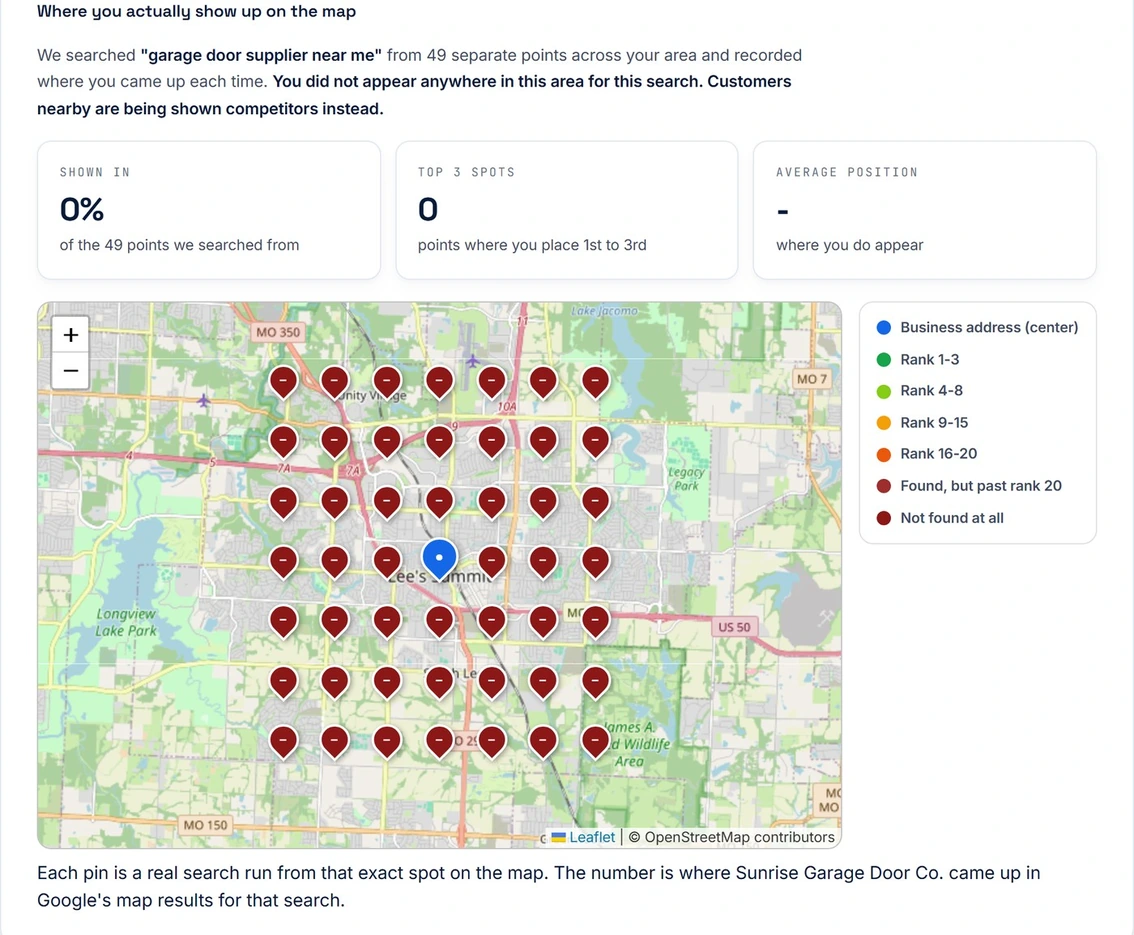
What check 1 actually looks like
One ranking number hides the truth.
Sitting at the top of the map beside your own office and being nowhere three miles away are both true at once. A grid of sample points around your area shows the shape of your coverage instead of one flattering number.
Part two
Then your website.
The listing gets you considered. The site is what decides whether the click turns into a call.
The website checks in full
- 6
One page per real service
Not one page listing nine services, and not nine pages that are quietly the same page.
- 7
The service and the place together
Say what you do and where you do it, in the words a customer would actually type.
- 8
Titles a person wrote
The title is the first line of your advertisement, not a bin to put keywords in.
- 9
The phone number as a link
Tapping it on a phone should start the call, not select the text.
- 10
Speed on a phone
Test on mobile, not on your desktop. A page that takes six seconds has already lost most of the people who clicked.
Part three
Then the signals around you.
Everything so far is yours to edit. These four are about what the rest of the web says.
- 11
Reviews answered
All of them, including the old ones. An unanswered review reads as an unattended business.
- 12
Your details consistent elsewhere
Wherever the business is listed, the name, address and phone should match exactly.
- 13
One mention that is not yours
A directory, a supplier page, a local association. Corroboration matters more than volume.
- 14
Something measured
Pick five keywords and a handful of points on a map, write down where you are today, and check again next month. Without a baseline, every claim about improvement is unfalsifiable.
What check 14 actually looks like
Something measured, not a guess a year from now.
Five keywords and a handful of points on a map, reported as they are, including the ones that went the wrong way. That row is the baseline check 14 is asking you to write down.

- Search visibility4.4%up 0.4How often your site is seen across these searches
- Average position48.8improved by 1.4271 tracked search terms, lower is better
- Estimated visits79271 termsFrom monthly searches and position, not clicks
When you have run it
The list is the easy half. Keeping it true is the job.
Every item here drifts: hours change, a category gets edited, a new directory copies an old phone number, reviews pile up unanswered. That is the part RankSteer takes over, and the part a one-off audit cannot help with.

Run your business.
Let RankSteer handle the visibility.
More customers, less busy work. A smarter way to grow locally.
- No card, no call
- Takes about two minutes
- The report is free
